Natural Disasters
Course Description
Students will be introduced to natural disasters; the processes and energy sources that produce them, along with the spatial distribution and pattern of natural phenomena, while developing an understanding of the impact these phenomena have on human activity.
- Determine what the roles are of natural disaster mitigation at a federal and local governmental level, community level, and individual.
- Analyze and understand natural processes that create disaster events such as: earthquakes, volcanoes, landslides, tsunamis, severe weather, disease, and climate change.
- Understand how natural hazards become disasters and ultimately catastrophes.
- Know how many natural processes are cylindrical meaning that they a frequency of recurrence which also influences their magnitude.
- Analyze the role humans play in creating natural disasters (i.e. population growth, poverty, environmental degradation, climate change, and politics).
- Understand the technology used to measure and analyze natural processes such as satellite imagery, aerial photography, Geographic Information Systems (GIS), Global Positioning Systems (GPS), and ground data.
Environmental Issues Of Overpopulation
Causes and Effects
One of the biggest environmental problems we face today is over-population. With over 7 billion people on the Earth today and is estimated to be between 8 and 11 billion by 2050. We are now adding one billion people to the planet every 12 years (about 220,000 a day), the human population will continue to grow exponentially. Scientists have said the Earth’s carrying capacity is between 4 and 16 billion, so at this estimate, overpopulation is already occurring. The issue with this is that our population will continue to use the Earth’s resources, decimating the land and wreaking havoc on the natural biodiversity of the Earth. It is aggravating the forces behind global warming, environmental pollution, habitat loss, the sixth mass extinction, intensive farming practices and the consumption of limited natural resources, such as fresh water, arable land and fossil fuels, at a speed faster than their rate of regeneration.
Overpopulation
occurs when a population’s density exceeds the capacity of the environment to
supply the health requirements of an individual, according to the EPA
(Environmental Protection Agency). Environmentalists have been long concerned
about the resources threatened by the rapidly going human populations, focusing
on the many environmental issues mentioned. But of these, the most threatening
and worse-case scenario for people experiencing overpopulation is lack of
fresh, clean water. “If the water goes, the species goes,” according to Lawrence
Smith, president of the Population Institute. There’s water all around us, but
97% plus is salt water, which leaves us with less than 3% that we use to
sustain our lives with. However most of the freshwater resources are either
unreachable or too polluted, leaving less than 1% of the worlds freshwater readily
accessible for direct human use. In fact, 1.1 billion people in the world do
not have access to safe drinking water and 2.2 people in developing countries,
most of them children, die every year from diseases associated with lack of
access to safe drinking water, inadequate sanitation and poor hygiene.
As the
population grows we face lack of biodiversity, there is more demand for certain
plants for food, clothing, paper, etc…
This has led to more intensive farming practices to produce more and
cheaper food per acre and animal, which has helped feed the booming population,
but has grown to become the biggest threat to the global environment through
the loss of ecosystem services and global warming and has led to emergence of
new parasites and is responsible for 80% of tropical forest deforestation. This
kills beneficial insects and plants, degrades and depletes the soil it depends
on, causes genetic erosion of crops and livestock species around the world,
which is a problem for biodiversity. On top of this, environmental degradation,
combined with growth in world population, is a major cause for increase in
human diseases, which contributes to the malnutrition of 3.7 billion people on
Earth. Everyday 3,000 people die from malaria – 3 out of 4 children. Every year
1.5 billion people die from tuberculosis, and another 8 million are newly
infected. There simply are not enough resources to continue to sustain
overpopulation, it increases malnutrition and inadequate or non-existent healthcare
on top of many other environmental issues.
Where Is It Occurring?
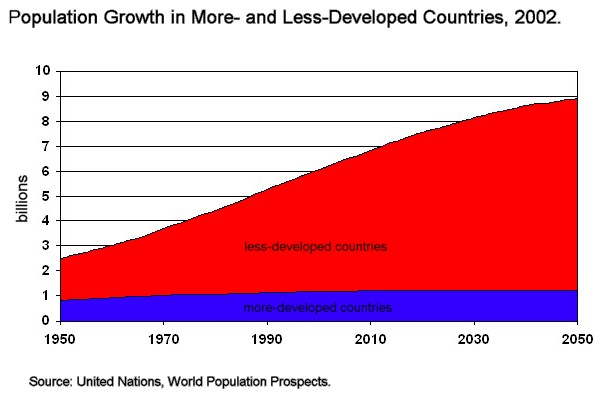
Developing nations face the issue of overpopulation more than developed countries, but it effects most of Earth world-wide as of now. Today less developed regions population is at 5.3 billion and is expected to increase to 7.8 billion is 2050. However, more developed countries will remain mostly unchanged at 1.2 billion. An exception to that is the United States which is expected to increase 44% by the year 2050. Nine countries are estimated to account for half of the world’s projected population increase including India, Pakistan, Uganda, Nigeria, Bangladesh, Ethiopia, and China.
Overpopulation is rising in countries such as China and India. By the year 2050 it is estimated that China will not be the most populous country in the world and will be surpassed by India. According to the U.S. Census Bureau’s International Database India will have more than 1.8 billion people competing for its resources. The 2007 U.S. Census Bureau and The United Nations Population set China’s current population at 1.3 billion and with India’s at around 1.1 billion. If population continues to grow at the estimated rate, such a fast growth rate in India between now and 2050 could lead to overpopulation and an uncertain future for the environment and the people living there.
By tradition, rural populations are larger than urban populations because rural families need to be larger to work and live off the land. But with urban populations families often have better education, health care, and family planning opportunities for families to choose how many children to have. Finally rural and urban populations are nearly equal. While the promise of jobs and prosperity and other factors have been pulling people to cities across the nations, so does 2 of the most pressing problems that face the world today, poverty and environmental degradation. In many poor countries, slums exhibit high rates of disease due to unsanitary conditions, malnutrition and lack of basic healthcare.
Why Is This Occurring?
The rising growth rates with are growing to overpopulation are results of many different factors. Advances in technology has affected humanity in many ways, one of which is better medical treatment to prevent disease and save lives. Advancement in medicine has provided more effective ways to control epidemics, give us better measures to treat critical health ailments, and an increase to the average life expectancy of humans. These medical advancements have also made it possible for couples who are unable to conceive to undergo fertility treatment methods and have more babies. Moreover, these advancements have given women safer pregnancies with good prenatal and healthcare. As a result to these advancements and good sanitation, it also gives more opportunities to allow more newborns to survive resulting in a significant population growth. Prior to these changes, 7 out of 10 children died before reaching reproductive age, today about 95% of newborns in developed nations reach adulthood.
There is also a lack of family planning, which is a big reason why developing, or poorer countries are growing populations at increasing rates. Modern methods of birth control and family planning don’t reach the illiterate populations of society. An estimated 350 million women in the poorest countries of the world either did not want or intend a child but lacked the information and resources for contraception options. Some cultures even promote beliefs and expectations of marrying at a certain age and having a certain amount of children.
Immigration is also an indicator leading to overpopulation, as an increase in immigration has become apparent. Most people prefer to move to more developed countries where the best facilities are available in terms of medical, education, security and employment. Those people who settle in those places become overcrowded. Immigration may not affect the overall world population figure, but can lead to localized overpopulation and cause uneven distribution of resources.
What Can Or Is Being Done?
What can be done and what is being done can take on two different factors. One is to reduce the rate of increase in which our population is growing, by lowering birthrates. One of the first measures to doing this is by better education, family planning, knowledge of contraception methods. Birth regulations have also been apparent in some countries. The second is eliminating the environmental effects overpopulation has on the Earth. This could be done by reducing pollutions, recycling and going “green”, conserving our resources, reducing deforestation, and providing clean water just to name a few. By doing these things we can take preventative measures to lessen the risk of the issue of overpopulation.
But
what is being done currently to tackle this issue? There are many organizations
who help women get birth control or other contraception methods and education.
There are also programs for those with little or no income to still gain contraception
solutions and education. China has instituted strict measures to reduce birth
rates by setting birth regulations. Religious and ideological opposition to
birth control has been cited as a factor contributing to overpopulation and
poverty. Some leaders and environmentalists have suggested an urgent need to
strictly implement China’s controversial one-child policy globally by the
United Nations to help control and reduce population gradually. However their
fines and punishments they impose for people breaking the law like forced sterilization,
and abortions have been receiving an uneasy response. Urban designer Michael E.
Arth has proposed some choice-based approaches which may appeal better to
people. One is a marketable birth license plan called “birth credits” in which
women would just have to buy licenses for each child she has over the allowed
allotment that would result in 0 population growth. Another approach would be
incentive to voluntary sterilization instead of as a consequence to breaking
child regulation laws, like compensation has been offered in India in the past.
As the world’s population grows at such a rapid rate, we are exploiting every resource faster than it can reproduce. Poor air and water quality, insufficient water availability, waste disposal problems, high energy consumption are exuberated by the increasing population density and demands of Earth’s resources. Increased climate change and global warming is largely due to this issue, people around the world are starting to address the problem by reducing their consumption of carbon and with better technology. But unsustainable human population growth can overwhelm those efforts. We need to solve the rest of the problems around this issue because as more people occupy this planet, the more room we will have to make by deforestation, desertification, and loss of other arable land which at the rate it’s going our rain forests could be diminished in the next 40 years. We either can wait for science to discover, create or work out these problems or take the matter in to our own hands while taking the corrective steps and make a significant impact.
"Solving the population problem is
not going to solve the problems of racism… of sexism… of religious intolerance…
of war… of gross economic inequality—But if you don’t solve the population
problem, you’re not going to solve any of those problems. Whatever problem
you’re interested in, you’re not going to solve it unless you also solve the
population problem. Whatever your cause, it’s a lost cause without population
control."
Bibliography
Ehrlich, P. R. (2015, March 23). Human Overpopulation. Retrieved from Wikipedia: http://en.wikipedia.org/wiki/Human_overpopulation#Fresh_water
Flostro. (2012, May 27). Over-Population: The Most Serious Environmental Problem for Science. Retrieved from Planet Save: http://planetsave.com/2012/05/27/over-population-the-most-serious-environmental-problem-for-science/
Hoevel, A. (2008, April 8). CNN. Retrieved from Overpopulation could be people, planet problem: http://www.cnn.com/2007/TECH/science/09/25/overpopulation.overview/index.html
Kukreja, R. (2015). Overpopulation. Retrieved from Conserve Energy Future: http://www.conserve-energy-future.com/causes-effects-solutions-of-overpopulation.php
TheVendor101. (2014, June 1). How Can We Control Human Over Population. Retrieved from YouTube: https://www.youtube.com/watch?v=Sabshk4bKj8
Tsiattalos, G. (2014). Causes of Human Overpopulation. Retrieved from Everything Connects: http://www.everythingconnects.org/overpopulation-causes.html
Urban Threats. (2015). Retrieved from National Geographic: http://environment.nationalgeographic.com/environment/habitats/urban-threats2/
Reflection
Doing this assignment has opened my eyes to many of the environmental issues occurring all around us. There was so many topics to choose from it was hard to pick only one. What I have noticed while doing research on environmental issues is that a lot of them tie into each other in one way or another. For example, while researching global warming in relation to overpopulation I learned that global warming is an effect of deforestation by cutting down trees that provide our atmosphere with a natural regulator of carbon dioxide and oxygen. With our forests getting cut down, and our automobiles and factory's releasing so much carbon dioxide in the air, there is more of the sun's radiation being reflected back to Earth instead of space. Environmental degradation is related to more diseases as our growth continues to increase, our water issues are related in part with waste problems. These are just a few of the many ways all our environmental problems are related in some way.
I was overall satisfied with my findings in researching this specific issue, because it has led me to learn about many other issues going on globally in the process. I usually don't pay attention to things going on out of our country, and when I do it is likely not environment related. This little bit of research is the start to learning more about important things going on in our world, and in different cultures around the world. I believe that if enough of us make steps in the right direction we can make a significant impact on our quality of life for our, and future generations.
